The Long Arc of Justice: A History of the Animal Liberation Movement
Explore the evolution of animal liberation, from ancient ethics to digital activism and modern nuanced debates.

History is often recorded as the story of expanding circles. We look back at the abolition of human slavery, the hard-won fight for women’s suffrage, and the ongoing struggle for civil rights as milestones in a grand narrative of moral progress. Within this tapestry lies a thread that is frequently overlooked yet profoundly radical: the movement for animal liberation. This movement does not merely ask for 'kindness' toward our fellow creatures; it seeks a fundamental restructuring of the legal and moral status of non-human beings. It is a movement that challenges the deeply ingrained anthropocentrism of Western thought, suggesting that the boundary of 'us' and 'them' should not be drawn at the species line, but at the capacity for suffering.
Foundations in the Ancient World
While the term 'animal liberation' gained its modern currency in the 1970s, its intellectual roots reach back millennia. In the East, the principle of Ahimsa—non-violence toward all living things—formed the cornerstone of Jainism, Buddhism, and Hinduism. This was not merely a dietary restriction but a sophisticated metaphysical recognition of the interconnectedness of life. In the West, Pythagoras and the early Neoplatonists argued against the consumption of flesh, not necessarily for human health, but out of a belief in the transmigrations of souls and the inherent kinship between humans and animals.

However, the dominant Western trajectory was set by Aristotle and later reinforced by Cartesian dualism. Aristotle’s 'scala naturae' placed humans at the apex, possessing a rational soul that animals supposedly lacked. Rene Descartes famously, and tragically, characterized animals as 'automata'—mindless machines that reacted to stimuli without true consciousness or feeling. This philosophical insulation allowed the industrial and scientific revolutions to exploit animal bodies with a clear, if misguided, conscience for centuries.
The Enlightenment and the Moral Turn
The first major crack in this Cartesian armor appeared during the Enlightenment. Philosophers began to pivot from 'reason' to 'sentience' as the metric for moral concern. Jeremy Bentham, the father of modern utilitarianism, penned the famous lines that still echo in animal rights literature today, asserting that when considering our treatment of animals, 'The question is not, Can they reason? nor, Can they talk? but, Can they suffer?' This shift was revolutionary; it decoupled moral worth from human-like intellect and tethered it to the biological reality of pain.
The Rise of Organized Advocacy
The 19th century saw the transition from philosophical debate to organized social action. In 1822, Irishman Richard Martin—fondly known as 'Humanity Dick'—helped pass the 'Ill-Treatment of Cattle Bill,' one of the first pieces of animal protection legislation in the world. Shortly after, in 1824, the Society for the Prevention of Cruelty to Animals (SPCA) was formed in a London coffee house. These early Victorian reformers were often also involved in the anti-slavery movement and the fight for child labor laws, seeing their work as part of a single humanitarian front.
“The greatness of a nation and its moral progress can be judged by the way its animals are treated.”
Yet, these early efforts were primarily 'welfarist.' They aimed to prevent 'unnecessary' cruelty while maintaining the status of animals as property or resources. It wasn't until the mid-20th century that the movement began to transition from 'protection' to 'liberation.' The formation of the Vegan Society in 1944 by Donald Watson and others marked a critical departure. They argued that if we are to truly respect animals, we must move beyond preventing overt cruelty and instead abolish the use of animals altogether.
1975: The Philosophical Big Bang
If the movement has a modern birth certificate, it is the publication of Peter Singer’s 'Animal Liberation' in 1975. Singer, an Australian philosopher, applied the utilitarian principle of 'equal consideration of interests' to non-human animals. He argued that speciesism—a prejudice based on species—was no more defensible than racism or sexism. Singer’s work provide a secular, rational framework for animal rights that bypassed sentimentality and focused on logical consistency.
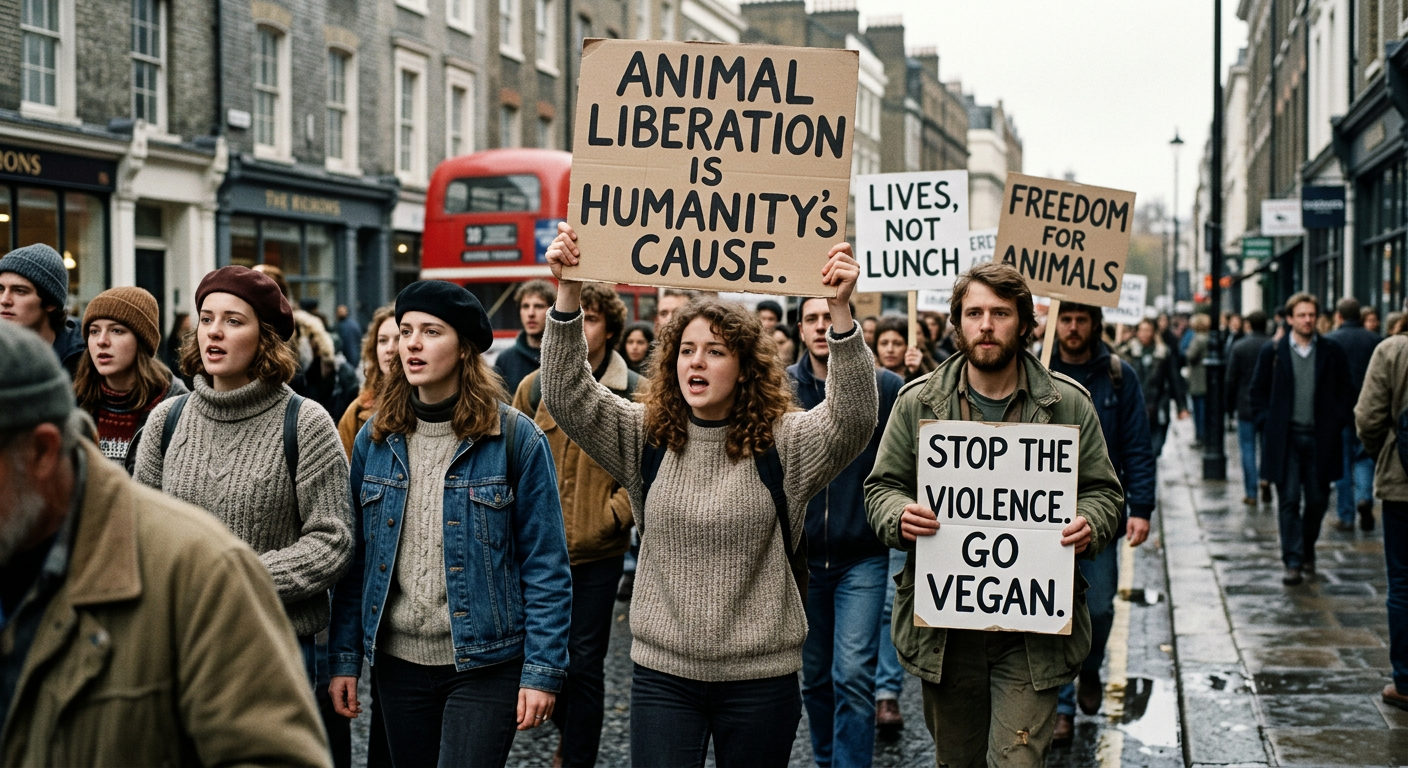
Close on Singer's heels came Tom Regan, whose 1983 book 'The Case for Animal Rights' offered a deontological counterpoint. Where Singer focused on consequences and suffering, Regan argued that animals are 'subjects-of-a-life' and possess inherent rights, including the right not to be used as a means to an end. Together, these thinkers provided the 'one-two punch' that gave the movement its intellectual heft, influencing a generation of activists to see animal exploitation not as a series of unfortunate abuses, but as a systemic injustice.
The Shift Toward Industrial Critique
As the movement matured, its focus shifted toward the largest-scale form of animal use: modern factory farming. The transition from small-scale agriculture to concentrated animal feeding operations (CAFOs) in the mid-20th century had hidden animal suffering behind windowless walls. The movement’s goal became one of making the invisible visible. Investigative journalism and undercover activism became vital tools in the animal liberation toolkit.
- Exposure of the 'battery cage' system in egg production.
- Highlighting the environmental impact of industrial methane emissions.
- Documentation of the psychological distress of animals in isolation.
- Advocacy for the decommissioning of biomedical research on great apes.
Science Catches Up: The Cambridge Declaration
One of the most significant recent developments in this history is not philosophical, but neurological. In 2012, a group of prominent scientists signed the Cambridge Declaration on Consciousness. This document stated unequivocally that non-human animals, including all mammals and birds, and many other creatures including octopuses, possess the neurological substrates that generate consciousness. This scientific consensus has effectively dismantled the last vestiges of the Cartesian 'animal-machine' myth, placing the burden of proof on those who continue to deny animal subjectivity.
The Future of the Movement
Today, the animal liberation movement is intersecting with other global crises, most notably climate change. The recognizing that animal agriculture is a primary driver of deforestation, water scarcity, and greenhouse gas emissions has transformed 'veganism' from a fringe ethical choice into a mainstream environmental imperative. We are moving toward what some call the 'post-animal economy,' where cellular agriculture and precision fermentation promise to provide the products humans want without the need for sentient sacrifice.
Greenhouse Gas Emissions per KG of Food Product
Source: Poore & Nemecek (2018), Science.
The history of animal liberation is not a straight line, but a widening circle. It began with ancient spiritual insights, moved through Enlightenment philosophy, and is now being codified in modern science and law. As we look forward, the movement faces new challenges, from the 'ag-gag' laws designed to silence whistleblowers to the ethical complexities of wild animal suffering. However, the core impetus remains the same: a relentless questioning of why the 'other' is less deserving of dignity and life than 'us.' In the long arc of justice, the liberation of animals may well be the final frontier of human moral development.
- Stage 1: Welfare - Minimizing pain within existing use systems.
- Stage 2: Rights - Granting legal protections against use.
- Stage 3: Liberation - Dismantling the human-animal hierarchy.
- Stage 4: Integration - Redesigning civilization to coexist with the wild.
Ultimately, the movement's success will not just be measured by the number of people who stop eating meat, but by a fundamental shift in the human psyche. It is a journey toward a world where we no longer see the natural world as a pantry or a laboratory, but as a community of which we are a part—not the masters.
The Digital Age: Amplifying Voices and Expanding Reach
The advent of the internet and social media has irrevocably transformed the animal liberation movement. Information that was once confined to academic journals or activist newsletters can now reach millions globally within seconds. Online platforms have become vital tools for awareness campaigns, fundraising, and coordinating action, democratizing participation and enabling grassroots initiatives to gain significant traction.
This digital revolution has also fostered new forms of activism. Viral videos exposing animal cruelty, online petitions garnering millions of signatures, and the rise of influential vegan influencers have all contributed to shifting public perception and encouraging dietary and lifestyle changes. The ability to share personal stories and scientific evidence instantaneously has created a more engaged and informed populace, pushing the boundaries of what was previously imaginable.
- Rapid dissemination of investigative journalism and undercover footage.
- Global coordination of protests and boycotts.
- Growth of online communities and support networks for activists.
- Increased accessibility of educational resources on animal ethics and veganism.
Beyond Abolition: Nuances in Modern Animal Ethics
While the abolitionist stance—advocating for the complete end of animal use by humans—remains a cornerstone, contemporary animal ethics is increasingly grappling with more nuanced positions. Discussions now delve into the ethical considerations of varying levels of animal welfare, the complexities of conservation efforts involving animals, and the potential for 'humane' farming practices, even as many argue these are inherently contradictory.
Furthermore, the movement is actively engaging with intersectional issues. The links between animal exploitation, environmental degradation, and social justice are becoming more widely recognized. This broader perspective acknowledges that the fight for animal liberation is intertwined with the struggle for a more equitable and sustainable world for all sentient beings.
- Exploring the ethical implications of de-extinction projects.
- Debating the role of animals in scientific research and medical advancements.
- Examining the impact of climate change on wild animal populations and habitats.
- Considering the ethical frameworks for managing human-wildlife conflict.
“The digital age has transformed the animal liberation movement from a niche concern to a global force for change, leveraging technology to amplify empathy and demand ethical consistency.”
Frequently asked questions
How has the internet changed animal activism?
Are there debates within the animal liberation movement about strategy?
What are some of the newer ethical considerations in animal rights?
How is data being used to advance animal rights?
Sources & further reading
- Poore & Nemecek — Science: reducing food's environmental impacts through producers and consumers
- Our World in Data — Environmental impacts of food production
- Academy of Nutrition and Dietetics — Position on vegetarian and vegan diets
- FAOSTAT — Livestock and food production data
- The Cambridge Declaration on Consciousness — Cambridge University, 2012
- Animal Sentience: An Interdisciplinary Journal of Public Policy, Education, and Ethics — Liverpool University Press
- Global Veganism: Trends and Market Insights — Various Market Research Firms (e.g., Statista, Mintel), Annual Reports
- World Animal Protection Legislative Tracker — World Animal Protection, Ongoing