Brown rice
Brown rice retains its bran and germ, giving it a chewier texture than white rice. Grain size and variety affect how it cooks.
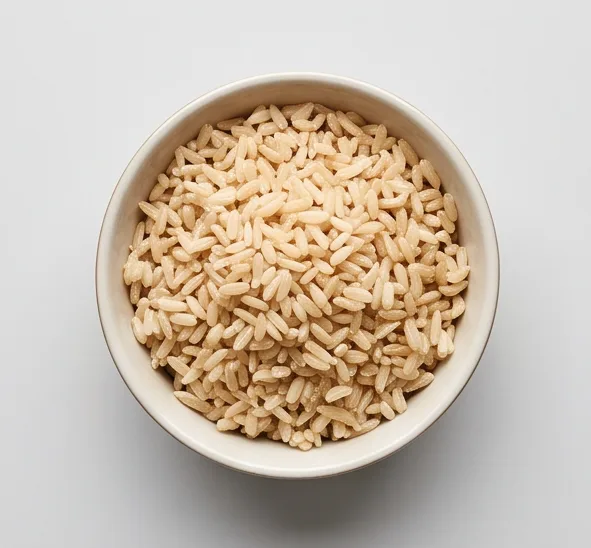
Nutrition per 100 g cooked
- Calories
- 111
- Protein
- 2.6 g
- Fat
- 0.9 g
- Carbs
- 23 g
- Fibre
- 1.8 g
Why it matters
- →A whole-grain source of carbohydrate
- →The figures refer to cooked rice
Common uses
Preparation and texture
Follow the water ratio and cooking method for your variety. Use as a bowl base with beans, tofu or vegetables, and cool any leftovers promptly.
What to check before using it
Cooked rice needs careful storage; do not leave it standing at room temperature for long periods. Reheating does not make badly stored rice safe.
Sources and limits
Nutrition figures describe the reference form and are approximate, not a laboratory analysis of your purchase. Variety, water content, processing and fortification can change the result. The sources below explain food composition, safe handling and nutrient guidance; they do not establish that an individual food treats a disease.
Wie Brown rice in einen normalen Esstag passt
The reference portion of Brown rice contains 111 kcal, 2.6 g of protein and 1.8 g of fibre per 100 g. Read these figures alongside the preparation state shown above: dry grains, cooked pulses and oils are not interchangeable portions. Multiply each figure by the weight you actually eat divided by 100. A food with little protein or fibre can still have a useful culinary role; it should not be described as a substantial source of those nutrients.
The usual uses of Brown rice are Grain bowls, Stir-fries, Sushi, Congee. Choose the portion and preparation for that role rather than assuming every ingredient should be the centre of a meal. For example, herbs season a dish, oils supply concentrated fat, and legumes can contribute protein and fibre. Check the ingredient's own nutrition values and combine it with complementary foods across the day.
Nährwerte pro 100 g – und wofür jede Angabe steht
| Nährstoff | Pro 100 g | Warum es wichtig ist |
|---|---|---|
| Calories | 111 | Energiedichte – hilft, die Portionsgröße im Verhältnis zum Rest des Tellers einzuschätzen. |
| Protein | 2.6 g | Unterstützt Muskelreparatur und Sättigung; besser über den Tag verteilen als auf einmal konsumieren. |
| Fat | 0.9 g | Trägt fettlösliche Vitamine und Geschmack; die Art des Fetts ist wichtiger als die Menge. |
| Carbs | 23 g | Hauptenergiequelle; Kohlenhydrate aus Vollkorn kommen mit Ballaststoffen und Mineralien. |
| Fibre | 1.8 g | Füttert Darmbakterien, stabilisiert den Blutzucker und ist der Nährstoff, an dem es den meisten Diäten mangelt. |
Kauf und Lagerung von Brown rice
- Compare the ingredient list and price for the form you need. A plain version may be useful, but fortified products can provide nutrients that an unfortified version lacks.
- Fresh, frozen, canned and dried products differ in water content, added salt and preparation. Compare nutrition using the same preparation state and a realistic serving, not package weight alone.
- Follow the package's storage instructions. Refrigerate perishable foods promptly; a dry cupboard is not appropriate for every ingredient.
- Buy only an amount you can store safely and use before spoilage. A lower unit price does not save money if part of the food is discarded.
Häufige Fehler
- Comparing dry and cooked weights as if they were equivalent. Water absorbed during cooking changes the nutrients per 100 g.
- Assuming every plant ingredient supplies meaningful protein, iron or fibre. Use the values above and the portion actually eaten.
- Ignoring food allergies, age-appropriate textures or a medical condition when choosing a serving.
- Assuming every ingredient can be eaten raw. Follow preparation instructions, especially for dried beans and foods requiring cooking.
Kochen mit Brown rice
Die üblichen Verwendungen sind Grain bowls, Stir-fries, Sushi, Congee. Jede davon ist eher eine Vorlage als ein Rezept: Sobald Sie wissen, wie sich Brown rice mit Hitze und Salz verhält, können Sie es in Mahlzeiten einbauen, die Sie bereits kochen, statt ein neues Gericht von Grund auf zu lernen.
Weitere Fragen, die Menschen stellen
Is Brown rice a good source of protein?
The reference value is 2.6 g per 100 g. Whether that makes a meaningful contribution depends on the serving you eat. A small amount used for seasoning or cooking fat is not equivalent to a main serving of beans or tofu. Compare the prepared portion, not just the ingredient name.
How much Brown rice should I eat in a day?
There is no universal serving suitable for every ingredient or person. Match the amount to its role, energy density and your overall diet. Allergies, medical conditions, age and preparation matter. A clinician or registered dietitian can advise on individual restrictions.
Is Brown rice suitable for children and older adults?
Suitability depends on the ingredient, preparation and person. Consider allergies, swallowing and chewing ability, choking hazards and medical restrictions. Whole nuts and hard pieces may need grinding or another texture adjustment. Do not assume an ingredient is safe or nutrient-dense solely because it is plant-based.
Does cooking change the nutrients in Brown rice?
Cooking may reduce some heat-sensitive vitamins while improving digestibility or making a food safe to eat. Water gain or loss also changes the figures per 100 g. Compare nutrition data for the same cooked or uncooked form, and follow safe preparation instructions rather than avoiding cooking to preserve nutrients.
Is Brown rice expensive?
Prices vary by region, season, brand and preparation. Compare the cost of the amount you will actually use, including waste and cooking time. An oil, spice or specialty ingredient cannot be judged as a cheap protein source when it supplies little protein in a normal serving.
Weiter entdecken
Verwandte Seiten zu Ersetzungen, Zutaten, Nährstoffen und Gerichten.