Judías blancas
También conocido como: cannellini, navy, great northern
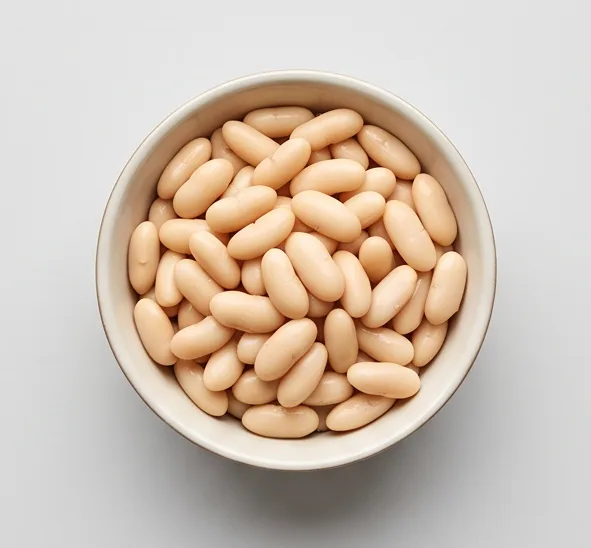
Las alubias blancas incluyen variedades como cannellini, alubia redonda o de riñón. Su sabor suave las hace muy útiles en sopas, patés vegetales y salsas cremosas para pasta.
Información nutricional por 100 g cooked
- Calorías
- 139
- Proteína
- 9.7 g
- Grasa
- 0.4 g
- Carbohidratos
- 25 g
- Fibra
- 6.3 g
Por qué es importante
- →Las alubias cocidas aportan proteínas y fibra
- →Las distintas variedades de alubia blanca difieren en tamaño y textura
Úsalo para sustituir
- • Nata en salsa para pasta (triturada)
Usos comunes
Combinaciones clásicas
Romero · Ajo · Aceite de oliva · Salvia
Preparación y textura
Triture alubias bien cocidas con agua o caldo de verduras para obtener una salsa cremosa. Conserve algunas alubias enteras en las sopas para dar textura y aromatice con romero, ajo o limón al gusto.
Qué comprobar antes de usarlo
Las alubias blancas secas también requieren una cocción segura. El cassoulet tradicional y algunos platos preparados de legumbres contienen carne; compruebe la receta completa.
Fuentes y limitaciones
Las cifras nutricionales describen la forma de referencia y son aproximadas, no un análisis de laboratorio de su compra concreta. La variedad, el contenido de agua, el procesamiento y la fortificación pueden modificar el resultado. Las fuentes que figuran a continuación explican la composición de los alimentos, su manipulación segura y las pautas sobre nutrientes; no determinan que un alimento específico sirva para tratar una enfermedad.
Cómo encaja Judías blancas en un día normal de alimentación
The reference portion of Judías blancas contains 139 kcal, 9.7 g of protein and 6.3 g of fibre per 100 g. Read these figures alongside the preparation state shown above: dry grains, cooked pulses and oils are not interchangeable portions. Multiply each figure by the weight you actually eat divided by 100. A food with little protein or fibre can still have a useful culinary role; it should not be described as a substantial source of those nutrients.
The usual uses of Judías blancas are Ribollita, Cassoulet, Crema de judías blancas. Choose the portion and preparation for that role rather than assuming every ingredient should be the centre of a meal. For example, herbs season a dish, oils supply concentrated fat, and legumes can contribute protein and fibre. Check the ingredient's own nutrition values and combine it with complementary foods across the day.
Nutrición por cada 100 g, y para qué sirve cada línea
| Nutriente | Por 100 g | Por qué importa |
|---|---|---|
| Calorías | 139 | Densidad energética: útil para juzgar el tamaño de la porción frente al resto del plato. |
| Proteína | 9.7 g | Apoya la reparación muscular y la saciedad; combínalo a lo largo del día en lugar de en una sola comida. |
| Grasa | 0.4 g | Transporta vitaminas liposolubles y sabor; el tipo de grasa importa más que la cantidad. |
| Carbohidratos | 25 g | Principal fuente de combustible; los carbohidratos de alimentos integrales vienen con fibra y minerales. |
| Fibra | 6.3 g | Alimenta las bacterias intestinales, estabiliza el azúcar en sangre y es el nutriente que más falta hace en la mayoría de las dietas. |
Comprar y almacenar Judías blancas
- Compare the ingredient list and price for the form you need. A plain version may be useful, but fortified products can provide nutrients that an unfortified version lacks.
- Fresh, frozen, canned and dried products differ in water content, added salt and preparation. Compare nutrition using the same preparation state and a realistic serving, not package weight alone.
- Follow the package's storage instructions. Refrigerate perishable foods promptly; a dry cupboard is not appropriate for every ingredient.
- Buy only an amount you can store safely and use before spoilage. A lower unit price does not save money if part of the food is discarded.
Errores comunes
- Comparing dry and cooked weights as if they were equivalent. Water absorbed during cooking changes the nutrients per 100 g.
- Assuming every plant ingredient supplies meaningful protein, iron or fibre. Use the values above and the portion actually eaten.
- Ignoring food allergies, age-appropriate textures or a medical condition when choosing a serving.
- Assuming every ingredient can be eaten raw. Follow preparation instructions, especially for dried beans and foods requiring cooking.
Cocinar con Judías blancas
Los usos habituales son Ribollita, Cassoulet, Crema de judías blancas. Cada uno de ellos es una plantilla más que una receta: una vez que sepas cómo se comporta Judías blancas con el calor y la sal, puedes incorporarlo a comidas que ya cocinas en lugar de aprender un plato nuevo desde cero.
Más preguntas que la gente hace
Is Judías blancas a good source of protein?
The reference value is 9.7 g per 100 g. Whether that makes a meaningful contribution depends on the serving you eat. A small amount used for seasoning or cooking fat is not equivalent to a main serving of beans or tofu. Compare the prepared portion, not just the ingredient name.
How much Judías blancas should I eat in a day?
There is no universal serving suitable for every ingredient or person. Match the amount to its role, energy density and your overall diet. Allergies, medical conditions, age and preparation matter. A clinician or registered dietitian can advise on individual restrictions.
Is Judías blancas suitable for children and older adults?
Suitability depends on the ingredient, preparation and person. Consider allergies, swallowing and chewing ability, choking hazards and medical restrictions. Whole nuts and hard pieces may need grinding or another texture adjustment. Do not assume an ingredient is safe or nutrient-dense solely because it is plant-based.
Does cooking change the nutrients in Judías blancas?
Cooking may reduce some heat-sensitive vitamins while improving digestibility or making a food safe to eat. Water gain or loss also changes the figures per 100 g. Compare nutrition data for the same cooked or uncooked form, and follow safe preparation instructions rather than avoiding cooking to preserve nutrients.
Is Judías blancas expensive?
Prices vary by region, season, brand and preparation. Compare the cost of the amount you will actually use, including waste and cooking time. An oil, spice or specialty ingredient cannot be judged as a cheap protein source when it supplies little protein in a normal serving.
Sigue explorando
Páginas relacionadas con esta en sustitutos, ingredientes, nutrientes y comidas.



