Vitamin B12 on a vegan diet: a reliable source is not optional
Quick answer
Every vegan needs a reliable B12 source: for healthy adults, a daily cyanocobalamin supplement or at least 2,000 mcg weekly, or fortified foods two or three times daily totalling at least 3 mcg. Check labels carefully. No unfortified plant food is dependable. Deficiency can take years to appear, and some nerve damage can become permanent.
B12 is made by micro-organisms, not by plants or animals. Vegans obtain reliable B12 from fortified foods or supplements. Supplement doses exceed food intake recommendations because active absorption becomes saturated at small doses; a small fraction of a large dose is absorbed by other routes.
Key facts
- Daily target used here
- 4 mcg
- Food sources listed
- 9
- Richest source
- Cyanocobalamin tablet — 100 mcg
- Supplement
- The simplest reliable routine
How much you need
Vegan Society adult prevention guidance
Vegan Society adult prevention guidance
Requires consistency; supplements are more reliable
NIH ODS: free B12 avoids impaired release from food
US RDA: 2.6 mcg in pregnancy; 2.8 mcg while breastfeeding
Where it comes from
Sort by Vitamin B12
Vitamin B12 per serving in plant foods, with the share of a 4 mcg daily target
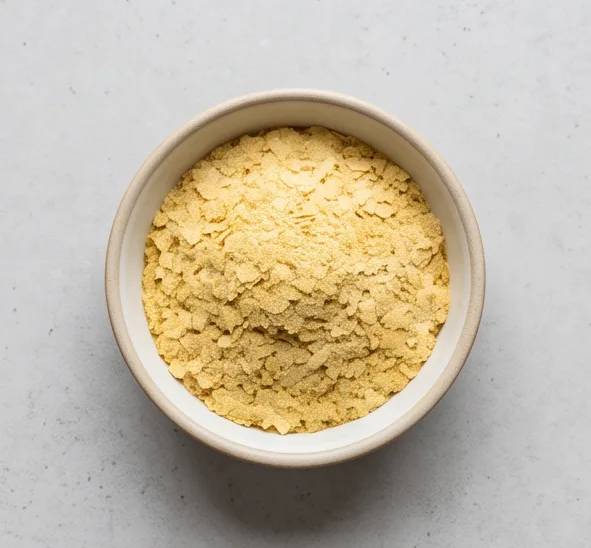
- Fortified nutritional yeast2 tbsp (10 g)5 mcg
NIH ODS — Vitamin B12 fact sheet
| Food | Serving | mcg | % of target |
|---|---|---|---|
| Cyanocobalamin tabletAbsorption varies with dose and individual factors | 1 tablet | 100 | 2500% |
| Fortified nutritional yeastOnly if the label says B12 added; Illustrative amount — check the product label | 2 tbsp (10 g) | 5 | 125% |
| Fortified soy milk | 250 ml (illustrative; check label) | 1 | 25% |
| Fortified oat milkMany organic brands are not fortified; Illustrative amount — check the product label | 250 ml | 1 | 25% |
| Fortified breakfast cereal | 40 g (illustrative; check label) | 1 | 25% |
| Fortified meat alternativesBrand-dependent — check the panel | 100 g | 1 | 25% |
| Fortified vegan spread | 10 g (illustrative; check label) | 0.5 | 13% |
| Spirulina, chlorella, noriNot dependable sources; active B12 and analogues vary | any | 0 | 0% |
| Tempeh, kombucha, sauerkrautB12 content varies; not dependable sources | any | 0 | 0% |
Getting it absorbed, not just eaten
Big doses absorb badly, which is why the dose looks huge
The active transport route handles only about 1.5–2 mcg per dose and then saturates for several hours. Above that, roughly 1% crosses passively. A 1,000 mcg tablet therefore delivers around 10 mcg — the arithmetic behind every 'why so much?' question.
Oral and sublingual tablets work similarly
Oral and sublingual B12 supplements show similar effectiveness. Supplemental B12 is already in free form and does not need stomach acid to release it from food; follow the product directions.
Cyanocobalamin is the best-evidenced form
Cyanocobalamin is a widely used, stable option. Methylcobalamin and hydroxocobalamin are also used; NIH ODS reports no evidence that supplement absorption differs by form. Ask a clinician about form and dose if you have kidney disease or a rare inherited optic neuropathy.
The simplest reliable routine
For healthy adults, at least 2,000 mcg cyanocobalamin weekly or a daily supplement is a simple routine. The Vegan Society daily minimum is 10 mcg. Follow label directions; pregnancy, suspected deficiency, metformin use or malabsorption warrant individual advice rather than simply adding a second source.
Signs of running low
- Tingling or numbness in hands and feet (early nerve involvement)
- Fatigue and breathlessness from macrocytic anaemia
- Memory problems, brain fog, low mood or irritability
- Sore, smooth, red tongue and mouth ulcers
- Unsteady walking and poor balance in advanced cases
- High-folate diets can mask the anaemia while nerve damage continues
What to test
- Serum B12
- Commonly used first test. Low cut-offs vary by laboratory; NIH ODS suggests checking MMA when B12 is 150–399 pg/ml (111–294 pmol/L), especially if symptoms or risk factors are present.
- Methylmalonic acid (MMA)
- A sensitive functional marker, but kidney impairment and older age can also raise MMA. Interpret alongside B12, symptoms and renal function.
- Homocysteine
- Rises in B12, folate or B6 deficiency; useful alongside MMA, not on its own.
- Full blood count
- Enlarged red cells (high MCV) hint at deficiency but appear late and are hidden by high folate intake.
Common mistakes
Trusting algae or fermented foods
Spirulina, nori and fermented foods are not dependable B12 sources. Their active B12 and analogue contents vary; use labelled fortified foods or supplements instead.
Stopping because a test came back normal
A normal result reflects a working supplement, not a diet that no longer needs one. Stores can last years, which is exactly why deficiency creeps up unnoticed.
Assuming plant milk is fortified
Organic ranges in the EU are frequently unfortified because organic rules restrict added vitamins. Read the panel each time you change brand.
Questions people ask
Can you get B12 from plants?
Not reliably. B12 comes from bacteria; the traces found on unwashed produce or in fermented foods are inconsistent and often inactive analogues. Fortified foods and supplements are the only dependable vegan sources.
How long before deficiency shows up?
The liver stores two to five years' worth, so someone who stops all sources may feel fine for a long time and then develop neurological symptoms. Do not use 'I feel fine' as evidence.
Can you take too much B12?
There is no established upper limit; excess is water-soluble and excreted. Very high doses can cause acne in some people, and people with kidney disease should discuss dosing with a clinician.
Do meat eaters need B12 too?
Many get it supplemented indirectly, since livestock feed is routinely fortified with cobalt or B12. Deficiency is also common in older omnivores because of reduced absorption, not intake.
Is B12 in toothpaste or spray better absorbed?
Oral and sublingual supplements can work similarly. Sprays and B12 toothpaste are not proven superior; choose a reliable product and follow its dose and frequency instructions.
References
Other nutrient guides
Data: NIH ODS — Vitamin B12 fact sheet · Free to reuse under CC BY 4.0 with a link back.
General information, not medical advice. Talk to a clinician or registered dietitian about your own situation.
继续探索
与本品相关的替代品、食材、营养和餐食页面。